
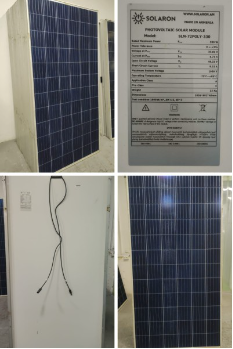
We recently had the opportunity to test our solar modules after five years of operation in natural conditions. Of course, we were very excited of this.
These were 72-polycrystalline cell (Poly PERC) modules with a declared rated power of 330W according to the STC standard at the time of production. But the measured power could have been higher. In our case, the measured power at the time of production was in the range of 330- 336 W.
Comparing the panel performance at the time of production and after several years of operation is interesting from both a scientific and economic perspective.
Taking into account that outdoor performance data is influenced by constantly changing environmental factors (temperature, irradiance, spectrum, pollution), testing of used modules under indoor conditions (STC) becomes crucial and makes direct comparisons of panels performance over time easy. This was all the more interesting because we tested these modules on the same factory equipment used at the time of production in 2019.
It’s well known that the industry has developed a situation where manufacturers claim a 1.5% power reduction in the first year (due to LID) and a 0.5% annual power reduction thereafter, or, in other words, guarantee 80-85% of the rated power after 25 years of operation.
The table below shows the panel specifications at the time of manufacture and after five years of operation.
| Solar Panel Serial Number (SN) | 12/2019 | 12/2025 | %lossover 5years | %lossperyear | %lossfromnameplateover5years |
| SLN1912P072Y471H0056 | 331.1W | 323.4W | 2.33% | 0.47% | 2.00% |
| SLN1912P072Y471H0057 | 330.6W | 325.4W | 1.59% | 0.32% | 1.41% |
| SLN1912P072Y471H0058 | 333.8W | 328.4W | 1.62% | 0.32% | 0.50% |
| SLN1912P072Y471H0060 | 333.0W | 326.6W | 1.91% | 0.38% | 1.04% |
| SLN1912P072Y471H0061 | 333.3W | 328.7W | 1.38% | 0.28% | 0.39% |
| SLN1912P072Y471H0063 | 333.6W | 328.5W | 1.52% | 0.30% | 0.45% |
| SLN1912P072Y471H0064 | 335.7W | 329.8W | 1.74% | 0.35% | 0.05% |
| SLN1912P072Y471H0065 | 333.0W | 328.1W | 1.48% | 0.30% | 0.57% |
| SLN1912P072Y471H0066 | 335.2W | 326.9W | 2.48% | 0.50% | 0.94% |
| SLN1912P072Y471H0067 | 333.9W | 329.1W | 1.43% | 0.29% | 0.26% |
| SLN1912P072Y471H0068 | 331.3W | 325.1W | 1.87% | 0.37% | 1.48% |
| SLN1912P072Y471H0073 | 333.3W | 325.8W | 2.27% | 0.45% | 1.29% |
| SLN1912P072Y471H0074 | 331.5W | 325.0W | 1.96% | 0.39% | 1.52% |
| SLN1912P072Y471H0078 | 332.5W | 326.5W | 1.80% | 0.36% | 1.05% |
| SLN1912P072Y471H0079 | 330.9W | 325.9W | 1.49% | 0.30% | 1.23% |
| SLN1912P072Y471H0080 | 330.1W | 328.0W | 0.63% | 0.13% | 0.62% |
| SLN1912P072Y471H0084 | 330.6W | 327.1W | 1.07% | 0.21% | 0.89% |
| SLN1912P072Y471H0103 | 330.5W | 326.3W | 1.25% | 0.25% | 1.12% |
| SLN1912P072Y471H0105 | 336.0W | 328.6W | 2.23% | 0.45% | 0.44% |
| SLN1912P072Y471H0110 | 330.7W | 326.4W | 1.30% | 0.26% | 1.09% |
| Average: | 1.67% | 0.33% | 0.92% | ||
Since I don’t have data on panel degradation in the first year of operation, I’ll assume linear degradation from the date of manufacture. In this case, the average power degradation over five years is 1.67%, which translates to an average annual degradation of 0.33%.
If we consider the degradation from the power indicated on the label, which is more reasonable from the customer’s point of view, then the average degradation over 5 years will be 0.92% or 0.184% per year.
Now let’s compare the permitted power reduction under our warranty for the first 5 years of operation with the actual
reduction. Let’s assume the power reduction is 1.5% in the first year of operation and 2% over the next 4 years (0.5% each year). Then, instead of the stated power of 330 W, we could have 318.5 W, but as we see, the worst-case power reduction is 323.4 W.
Technology is changing rapidly, and polycrystalline PERC panels like these are already a thing of the past. However, since many of our customers use these panels, we can confidently say they are worth the cost and fully meet their stated specifications. I sincerely hope that we will continue this practice of delivering panels from the field to our lab for testing. And soon we will have data on other types of panels as well. This is not only in our interests, but also in the interests of our customers.
I would like to point out that laboratory tests were carried out in their original condition, without any additional cleaning of the panels.
V. Sharafian
CTO, Co-founder, Solaron